‹ Back to all stories
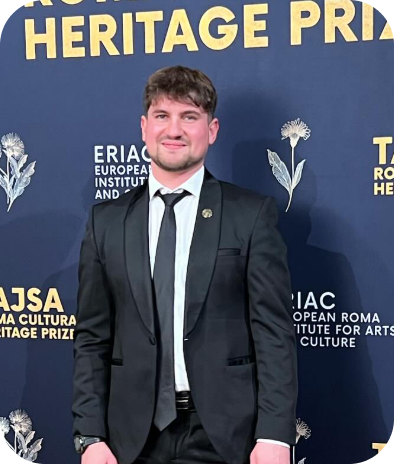
Faton Mustafa as Content Production Manager to Amaro Than
Amaro Than Team · Nov 24, 2025
For as long as he can remember, Faton Mustafa has treated the camera not as a gadget, but as a key—a way to open doors that were closed to Roma people, and especially to Roma youth.
Growing up as a Kosovo Roma, he saw how stories about his community were almost always told by others, often reduced to stereotypes or short clips of “poverty and problem.” What he didn’t see were the layers he knew were real: humour, creativity, talent, love, ambition. That gap between reality and representation is what pushed him toward film, journalism, and activism. If the world wouldn’t show Roma life honestly, he would.
Over the last 20 years, Faton has worked across Kosovo, Serbia, Croatia, and Montenegro, turning his lens on the streets, homes, festivals, and quiet corners where Roma life unfolds. His documentaries have explored education, discrimination, migration, identity, and everyday survival—but always through the eyes of people themselves. He sits with families in their kitchens, walks with youth through their neighbourhoods, and listens before he records. The result is a body of work that does more than “raise awareness”; it restores complexity and dignity to people who are often flattened by mainstream narratives.
As a journalist, he has reported on social issues, policy changes, and grassroots initiatives affecting Roma communities. He moves easily between local stories and regional context, connecting what happens in a single settlement to the larger structures that shape people’s lives. His journalism is grounded, detail-rich, and focused on impact: Who will see this? What will they understand differently after watching or reading? How can this story lead to change?
Alongside filming and reporting, Faton has always been present as an activist. He designs and supports initiatives that invite young Roma to step in front of the camera, to speak publicly, to claim space. For him, empowerment is not an abstract word; it is a process of handing over tools, sharing skills, and standing beside youth as they try something new.
In workshops he has led across the region, he teaches young people how to frame a shot, structure a story, and ask good questions. But more importantly, he teaches them that their experiences are worthy of attention. He tells them, “You are not just subjects; you are authors.” Many of the young people he once trained now lead their own projects, campaigns, and creative work, continuing the cycle he started.
This combination of filmmaking, journalism, and grassroots organising is what defines Faton’s approach: he doesn’t separate art from responsibility. Every project asks the same question—how can this piece of work shift the way Roma are seen, and the way Roma see themselves?
When he joined Amaro Than as **Content Production Manager**, it wasn’t a career move; it was a continuation of the same mission in a new space.
Amaro Than is building a digital platform where Roma and non-Roma can meet naturally, through creativity, culture, and everyday connection. For such a mission, content is not decoration—it is the heartbeat. Faton’s role is to shape that heartbeat: to ensure that every video, photo, interview, and story feels real, rooted, and respectful.
He brings with him two decades of experience across media landscapes: independent film, TV, digital platforms, grassroots campaigns, and community screenings. He knows what it means to work with small budgets and big ideas. He knows how to get powerful images in difficult conditions. He knows how to earn trust in communities that have every reason to be cautious.
At Amaro Than, Faton uses this experience to design a content universe that is **authentic, bold, and community-driven**.
He works closely with youth, artists, and local leaders to identify the stories that need to be told: the young student who is the first in their family to attend university; the musician blending traditional sounds with modern beats; the activist fighting for housing rights; the grandmother keeping language and songs alive. He approaches each piece with the same principles he has followed all his life: no exploitation, no sensationalism, no “poverty as spectacle.” Instead, he focuses on dignity, pride, humour, and resilience.
Behind the scenes, he builds production workflows that can grow with the platform. He helps set guidelines for filming, editing, and publishing that protect people’s privacy and safety. He mentors younger team members and community contributors, showing them how to turn raw footage into coherent narratives without losing the soul of the story. He pushes for quality, not just in equipment and editing, but in intention.
A typical project under his leadership might start with a simple question: “What is one thing you wish people knew about your life?” From there, he collaborates with the subject to shape the story. Maybe it becomes a short documentary, a series of social clips, or a visual essay. Whatever the format, he stays close to the original voice, letting the person speak in their own words, in their own language, in their own style.
He also understands that Amaro Than exists in a fast-paced digital landscape. Algorithms favour quick, catchy content—but Faton is determined that speed will never come at the cost of respect. He experiments with forms that work online—short videos, reels, teasers—but each piece still carries weight. Even in 30 seconds, he insists on truth.
Importantly, Faton’s work strengthens not only how Amaro Than looks, but how it is perceived. His visual storytelling sharpens the platform’s identity: this is not a place of clichés or charity; it is a place of power, culture, and connection. When someone encounters Amaro Than for the first time through a video or campaign he has helped shape, they should feel three things: **real people, real emotion, real purpose**.
On a broader scale, his presence helps push the Roma narrative onto a global digital stage. With his experience working across different countries and media systems, he knows how to frame stories in ways that resonate beyond local borders while staying faithful to local realities. He understands how to talk to international audiences without diluting the specifics of Roma life. This skill is crucial as Amaro Than grows and reaches people who may have little knowledge of the community but are open to learning.
Looking ahead, Faton imagines a future where Roma youth are not only featured in content, but are leading entire production teams, directing their own series, and running their own media channels under the wider Amaro Than ecosystem. He sees the platform as a training ground as much as a publishing space—a place where young creators can learn, experiment, and eventually build careers in media, film, and digital communication.
In every decision, one principle guides him: **every story must reflect dignity, pride, and truth**. No matter how big Amaro Than becomes, he wants people to recognise themselves on the screen and feel, “This is us. This is honest. This is ours.”
From the streets of Kosovo to film sets across the Balkans, from community halls to digital platforms, Faton Mustafa has carried one mission for 20 years: use storytelling to open doors for Roma youth. At Amaro Than, he continues that mission—now with a new set of tools, a bigger stage, and a community ready to tell its story in its own voice.

 Featured